Is It Ethical to Use AI for Content Creation? Yes. With One Condition.
Is it ethical to use AI to create content for my business? Yes, it is. With one condition: the AI has to actually know your voice before it writes a single word on your behalf. Without that, you are not using AI. You are letting AI use your platform.
But that answer probably does not settle what is really going on in your head. Because the question was never really about ethics in the abstract. It was about you, specifically, wondering if the thing you published last Tuesday was honest. Wondering if someone is going to call you out. Wondering if the woman in your industry who writes everything herself is more legitimate than you are.
You are not asking a philosophy question. You are asking a guilt question. And you are asking it while your competitor already posted three times this week, presumably without losing any sleep over it.
Here is what this post covers: where the guilt comes from, what actually makes AI content unethical, and how to use AI in a way that is not just defensible but genuinely yours. The condition is specific. And once you understand it, the guilt stops making sense.
Where the Guilt Actually Comes From
The guilt has layers, and none of them are as rational as they feel.
The first layer is imposter syndrome wearing a new outfit. You already worried you were not qualified enough, experienced enough, visible enough. AI just gave that fear a fresh vocabulary. Now instead of “Am I good enough to write this?” it is “Am I even the one writing this?” Same fear. Different mask.
The second layer is comparison. You see someone post a long caption about how they write every word themselves, and you feel a twist in your stomach. You are measuring your behind-the-scenes against someone else’s performance. And that person might be using AI too. A 2024 Salesforce survey found that 75% of marketers are using generative AI tools in some capacity. Three out of four. The silence around it is the problem, not the usage.
The third layer is the word “cheating.” It comes up constantly. Women entrepreneurs especially use this word, and it is worth examining why. Nobody calls it cheating when you hire a copywriter. Using Canva instead of designing from scratch does not count as cheating either. Nobody calls it cheating when you use a calculator instead of doing the math longhand. But somehow, using AI to draft content from your own ideas feels like you are getting away with something.
(The bar for what counts as “real work” is suspiciously higher for women who run businesses than for anyone else. That is not an accident.)
The guilt is not evidence that you are doing something wrong. It is evidence that the cultural script around who deserves to take shortcuts has not caught up with the technology yet. You can wait for it to catch up. Or you can keep publishing.

The One Condition That Makes AI Content Ethical
Here is where AI content creation ethics actually live: not in whether you used AI, but in whether the AI knew what it was talking about when it spoke as you.
Generic AI output is the real problem. When you open a tool, type “write me a LinkedIn post about marketing,” and publish whatever comes back, that is not your content. That is a content-shaped object. It has no voice. There is no point of view. It has no specific detail that could only come from your experience. The result could belong to anyone, which means it belongs to no one.
Voice-trained AI is different. When you have documented how you actually talk, what words you use and avoid, what your opinions are, what your audience cares about, and you feed all of that into the tool before asking it to write, the output is built on your foundation. You are not outsourcing your thinking. You are outsourcing the labor of turning your thinking into sentences.
That distinction matters. A lot.
Think about it this way. If you sat down with a skilled ghostwriter for three hours and told them everything about your business, your audience, your perspective, and your pet peeves, and they wrote a blog post based on that conversation, nobody would question the ethics. The AI is doing the same thing. Speed is the only difference.
The condition is not “always disclose.” The condition is deeper than that. The condition is: the AI has to actually know your voice first. Not a generic brand voice template. Your voice. Your specific patterns, your opinions, your way of landing a point. When that foundation exists, using AI authentically for business is not a shortcut. It is a workflow.
Without that foundation, it is just content from nowhere.
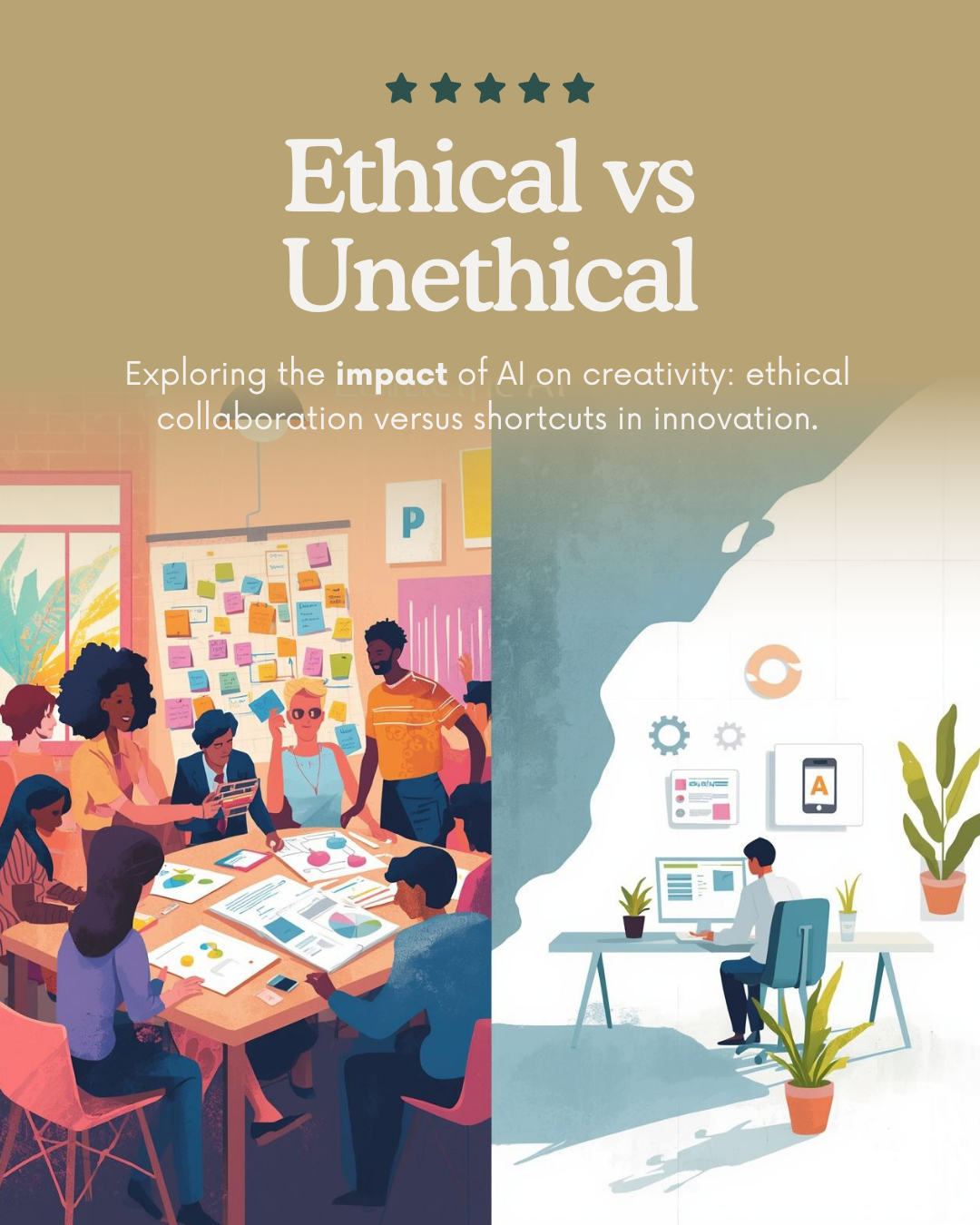
What Unethical AI Content Actually Looks Like
The line is not hard to find. Here is what is on the wrong side of it.
Copying without input. Generating content with no original thinking behind it. No voice memo. Zero notes or perspective. Just a prompt and a publish button. The AI did not assist you. It replaced you.
Zero editing. Publishing a first draft without reading it, changing it, or adding anything specific to your experience. If you cannot point to a single sentence you added or changed, the content is not yours.
Passing off AI-written work as handcrafted. This is the one that gets people in trouble. If someone asks how you create your content and you say “I write every word myself” while ChatGPT is doing 90% of the work, that is deception. Not because you used AI. Because you lied about it.
No voice, no specificity. Content that could have been written by anyone about anything. No named client stories (even anonymized). Not a single specific number. No actual opinion that someone could disagree with. This is the most common version of unethical AI content, and it is also the most boring.
The ethical line is not about the tool. It is about whether a real human perspective went in before the content came out.
How to Use AI Without Losing Your Voice
This is the practical part. Four steps, and none of them require a certification or a course.
Step 1: Document your voice before you prompt anything. Write down 10 sentences that sound like you. Not polished. Not your best copy. Sentences from emails, DMs, or conversations where you sounded the most like yourself. These become your voice reference.
Step 2: Feed it to the AI. Before you ask for a draft, paste your voice reference into the conversation. Tell the AI: “This is how I write. Match this tone, sentence length, and level of specificity.” Do this every session until you have a saved system prompt or custom instruction set.
Step 3: Edit everything. Read the output out loud. If a sentence does not sound like something you would say at a dinner table, rewrite it. Add the detail only you would know. The client who said that one thing. That Tuesday when everything went wrong. The number that proves your point. Editing is where your voice lives.
Step 4: Be transparent when asked. You do not need a disclaimer on every post. But when someone asks how you create content, tell the truth. “I use AI as a drafting tool and edit everything myself.” That sentence has never cost anyone a follower. Dishonesty about it has.
AI tools for marketing content ethical concerns come down to this: input your real thinking, review the output, and do not lie about the process. That is the whole framework.
(If your AI-generated content sounds exactly like everyone else’s AI-generated content, the problem is not the AI. It is that you skipped steps 1 and 2.)
Frequently Asked Questions
Sources
Generative AI Statistics — Salesforce, 2024
How Language Models Hallucinate — Stanford University, 2023