How to Make AI Content Sound Like You (Not Like Everyone Else’s Template)
She spent 40 minutes on a single Instagram caption. Rewrote the hook three times. Swapped out the call to action twice. Asked ChatGPT to “make it more conversational.” Then “more punchy.” Then “more like me.”
She posted it anyway. It sounded fine. Professional, even. And absolutely indistinguishable from every other coach, consultant, and course creator in her niche.
Here’s the direct answer to the question most people are actually asking: How do I make AI-generated content sound like my own voice? You give the AI your voice before you ask it to write. Not after. Never through editing alone. Not through a better prompt template you found on Twitter. You document how you actually talk, what you believe, what you’d never say, and you hand that to the tool before it generates a single word.
That’s it. That’s the fix.
The problem was never the AI. The problem is that you asked a machine to sound like you without telling it who you are. And then you blamed the output.
I’ve done it too. More than once. I’d stare at a paragraph that felt like it was written by a polite stranger wearing my name tag, and I’d think the tool was broken. It wasn’t. I just hadn’t given it anything real to work with.
Let’s talk about why.
Why AI Content All Sounds the Same
Large language models generate text based on patterns. That’s not a flaw. That’s literally how they function. When you type “write me a caption about mindset for female entrepreneurs,” the AI pulls from millions of posts about mindset for female entrepreneurs. What you get back is an average. A composite. The most statistically likely version of that content.
So when your AI content sounds generic, it’s not because the tool is bad. It’s because you gave it a generic request. You asked for a caption about mindset. You got the caption about mindset. The one that already exists everywhere.
A 2024 study from the University of Tübingen found that AI-generated text was rated as more “typical” and less “distinctive” than human-written content across every category tested. Readers couldn’t always identify it as AI-written. But they consistently described it as forgettable. That word came up over and over. Forgettable.
This is the part where most advice tells you to “add your personality” in the editing phase. To sprinkle in some personal stories. To “make it your own.”
That advice isn’t wrong. It’s just incomplete. Because if you’re editing every single output to inject voice after the fact, you’ve turned AI into a rough draft machine that creates more work, not less. And you’re still starting from that same generic baseline every time.
The real reason AI content sounds like everyone else’s is simpler than people want it to be: you didn’t give the AI a reason to sound different. No voice notes. Zero context about your opinions. No list of words you’d actually use versus words that make you cringe. Nothing.
You handed it a blank slate and got upset when it filled it in with beige.
The Part Nobody Told You About Prompts
Here’s where the “you are using AI wrong” conversation usually goes sideways.
Someone notices their content sounds flat. They Google “how to tell if your AI prompts are ineffective.” They find a thread or a reel with 15 prompt frameworks. They try them. The output improves slightly. (Most of them work, by the way. For about a week.) Then everything slides back to generic because the underlying problem hasn’t changed.
A prompt is a question. A better prompt is a better question. But a better question asked to someone who doesn’t know you still produces a stranger’s answer.
Think about it this way. If you walked up to a copywriter you’d never met and said, “Write me a LinkedIn post about boundaries in business,” you’d get something competent and forgettable. Not because the copywriter is bad. Because they don’t know your voice, your audience, your take on boundaries, or the specific client story that made you care about the topic in the first place.
That’s what you’re doing every time you open a chat window and start prompting from scratch.
The fix is not a better prompt. The fix is upstream of the prompt entirely. It’s the context layer. The document that tells AI who you are before you ask it to write anything.
I resisted this for longer than I should have. I kept thinking I could just write more detailed prompts. Add more instructions. Specify tone. I’d type things like “write in a warm but direct tone, slightly sarcastic, with short paragraphs.” And the AI would try. Bless it, it would try. But “warm but direct” means something different to every person who reads it. Without examples, without specifics, without your actual language patterns, the AI is still guessing.
And AI guesses toward the middle. Always.
How to Make AI Actually Sound Like You
This is the practical part. Here’s what actually works.
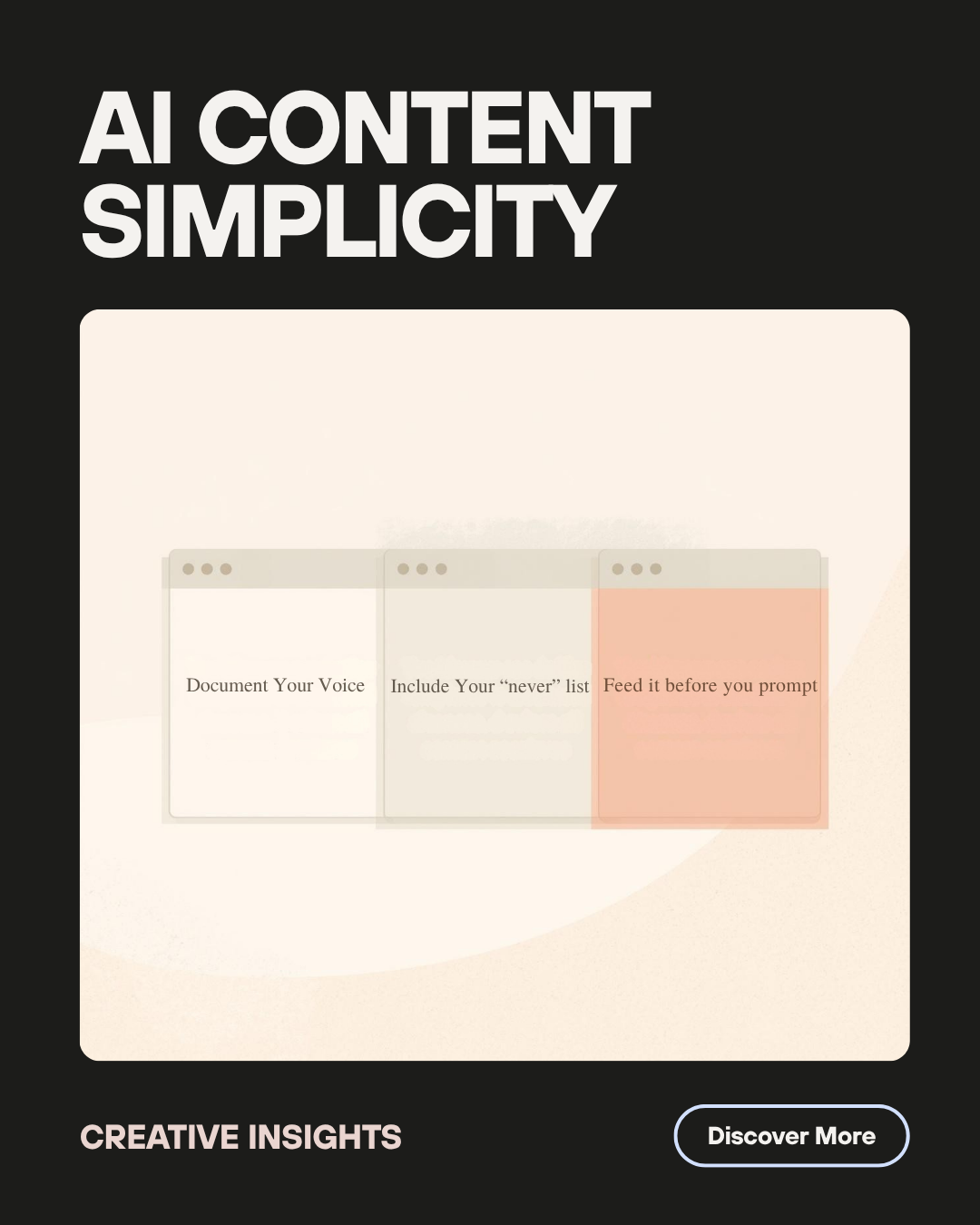
Step one: Document your voice. Not in abstract terms. In specific, concrete details. Write down phrases you use all the time. Write down words you’d never use. (I will never unironically use the word “abundance” in a business context. That’s a voice detail.) Write down your opinions on your topic. Not safe opinions. Your real, actual, slightly uncomfortable opinions. Write down how you start sentences when you’re being honest in a text to a friend.
Step two: Include your “never” list. This matters more than people think. Voice is as much about what you reject as what you embrace. If you’d never open a post with “Let’s talk about…” then say so. Hate exclamation points? Note it. If you think the phrase “show up authentically” should be retired permanently, that’s useful information for the AI.
Step three: Feed it before you prompt. Give the AI your voice document at the start of the conversation. Before you ask for anything. Let it read who you are before it tries to be you.
Step four: Edit with your ear, not your eyes. Read the output out loud. Not in your head. Out loud. Your eye will skim past sentences that “look” fine. Your ear will catch every phrase you’d never actually say. If it sounds like a LinkedIn influencer and you’re not a LinkedIn influencer, something’s off. Trust that instinct. It’s faster than any checklist.
This process takes about 90 minutes to set up the first time. After that, you’re copying and pasting a document. The ROI is every piece of content you create from that point forward.
What “Good Enough” AI Content Actually Looks Like
Here’s the bar. And it’s lower than you think.
Good AI content that sounds like you doesn’t sound like your best keynote. It sounds like your Tuesday. Like the way you explain things to a client over coffee. Your real voice at regular volume.
If you’re reading your AI-generated post and it sounds like you on a stage, it’s probably overwritten. If it sounds like you in a meeting, you’re closer.
The goal is not perfection. The goal is recognition. Could someone who knows you read this and think, “Yeah, that sounds like her”? Not “that sounds like a polished version of her.” Just her.
I stopped chasing perfect AI output about six months ago. Now I aim for 80% there. The last 20% is a quick pass where I read it aloud, swap three or four phrases, and cut whatever feels like filler. Total editing time: 10 to 15 minutes. Down from the 40 minutes of reworking I used to do when I was prompting without context.
That’s the difference. Not a different tool. Not a $47 prompt pack. A voice document and a pair of ears.
FAQ
Sources
AI Research — Understanding Language Model Outputs — University of Tübingen AI Center